
Clay County Criminal Court Cases
Clay County sits in Tennessee's 13th Judicial District. Circuit Court tries felony cases. General Sessions Court hears misdemeanors, preliminary hearings, and the first stages of felony matters. A qualifying General Sessions appeal receives a new, or de novo, hearing in Circuit Court. Celina City Court keeps its own municipal and ordinance matters. These levels matter because a name search made at only one counter can miss a file held at another.
The Clay County Circuit Court Clerk is the key custodian for the county court file. Keshia Smith's office accepts court inquiries at 931-243-2557, Monday through Friday from 8 a.m. to 4 p.m. Its mailing address is P.O. Box 749, Celina, TN 38551. Ask whether the matter belongs in Circuit or General Sessions, then request the docket and disposition by case number when possible.
The official clerk page shows the local counter and staff information used for Clay County court case requests.
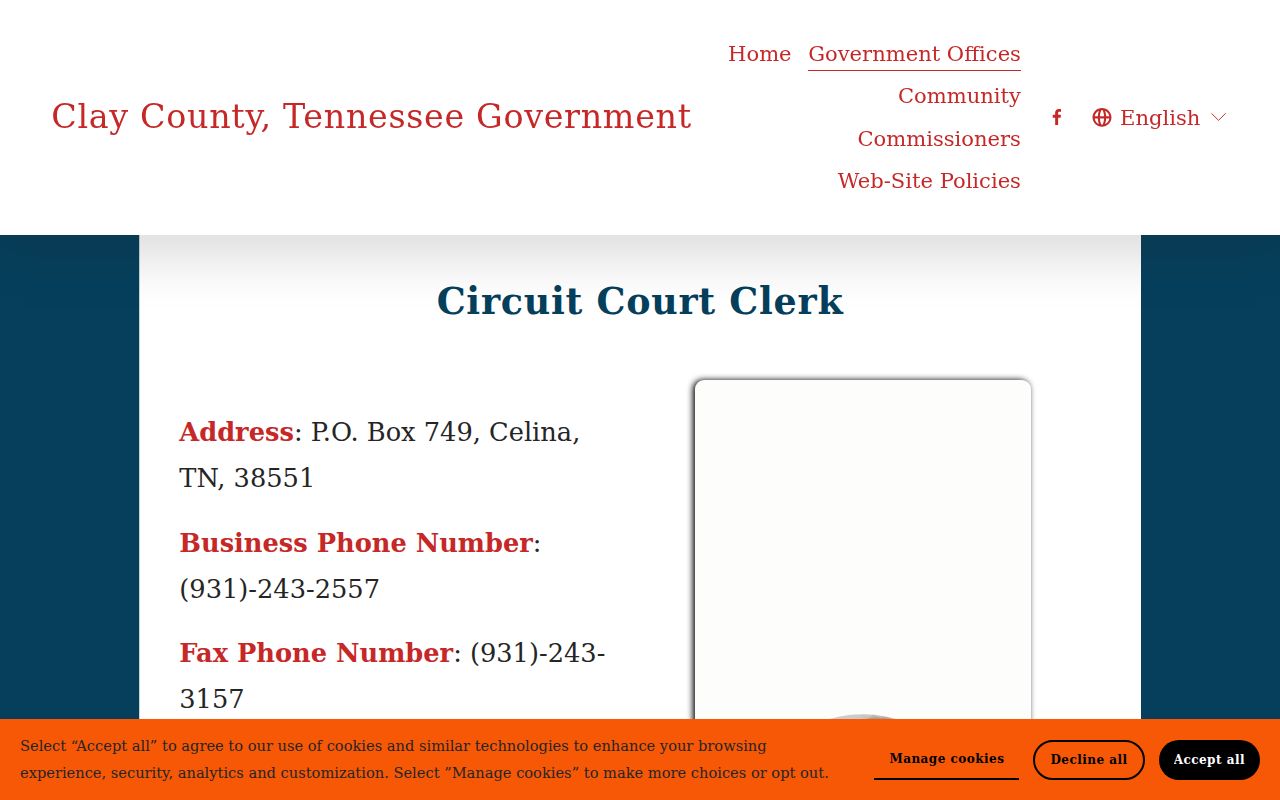
That source is the best place to confirm hours and contact details before a trip to Celina.
Clay County Courts Compared
Court level tells a reader what part of a Clay County criminal case may be available. General Sessions handles the early file for many prosecutions, including warrants, preliminary steps, misdemeanors, and financial entries. Circuit holds felony trials and later proceedings. Celina City Court has a separate municipal file. The Tennessee court clerk directory lists both county and city clerks, which helps route a request without treating their records as one database.
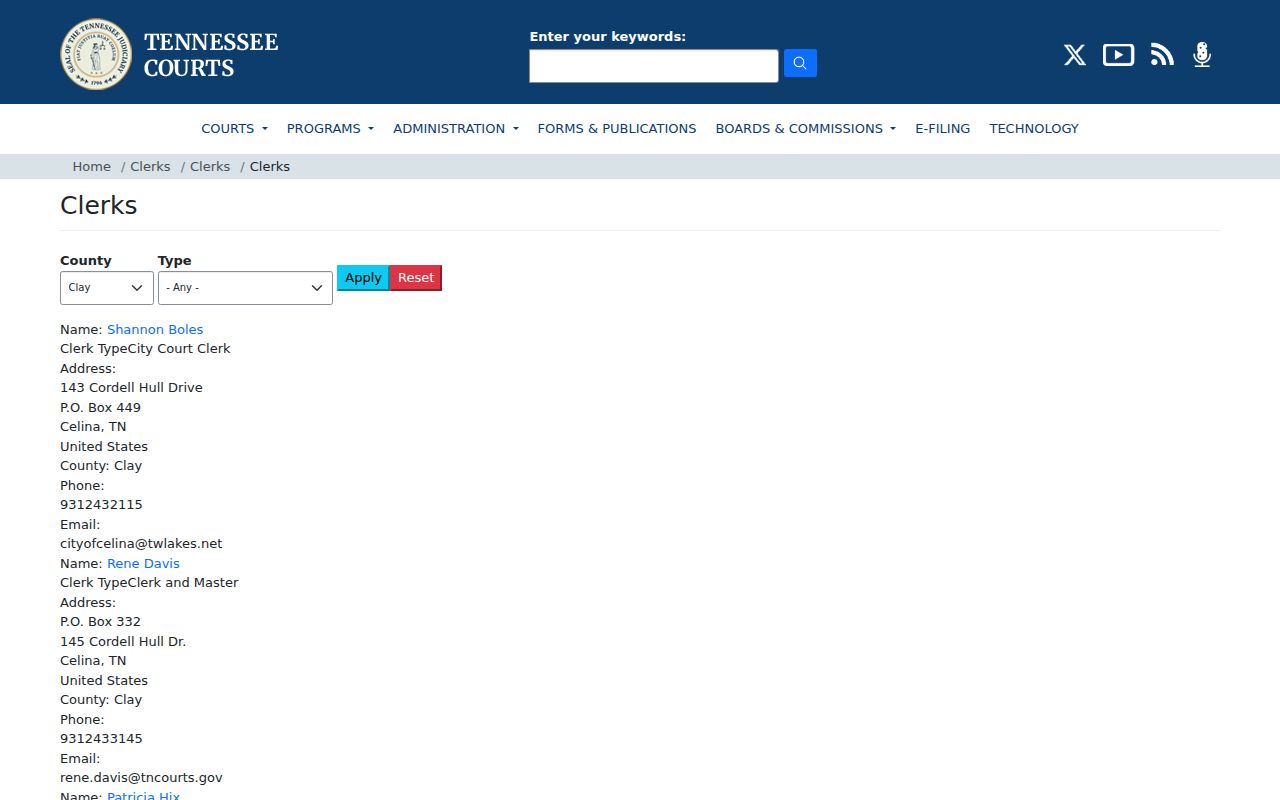
The directory confirms that a municipal matter may require a separate Celina contact.
Clay Circuit Court Clerk
145 Cordell Hull Drive
Mail: P.O. Box 749
Celina, TN 38551
931-243-2557
Monday-Friday, 8 a.m.-4 p.m.
Celina City Court
143 Cordell Hull Drive
P.O. Box 449
Celina, TN 38551
931-243-2115
Note: Judge chamber addresses outside Clay County are not substitutes for filing or requesting records at the Celina clerk counter.
Searching Clay County Case Records
No official online Clay County trial-case portal was located. A clerk-assisted search is therefore the main route. A full name and a narrow date range help staff distinguish similar entries. Add the case number, court level, and charge if known. Fees for searches, plain copies, and certified copies were not posted, so ask for the price and delivery time before placing an order.
- Call the Clay County clerk and state whether the inquiry concerns Circuit or General Sessions Court.
- Give the full name, approximate filing year, and case number if one is known.
- Ask for the docket sheet and disposition first. Those items identify the case path and result.
- Select only the charging paper, order, judgment, or other public filing actually needed.
- Ask about copy cost, certification, archive retrieval, and turnaround before ordering.
The Administrative Office of the Courts listing gives the official Clay courthouse entry used to verify the court destination.
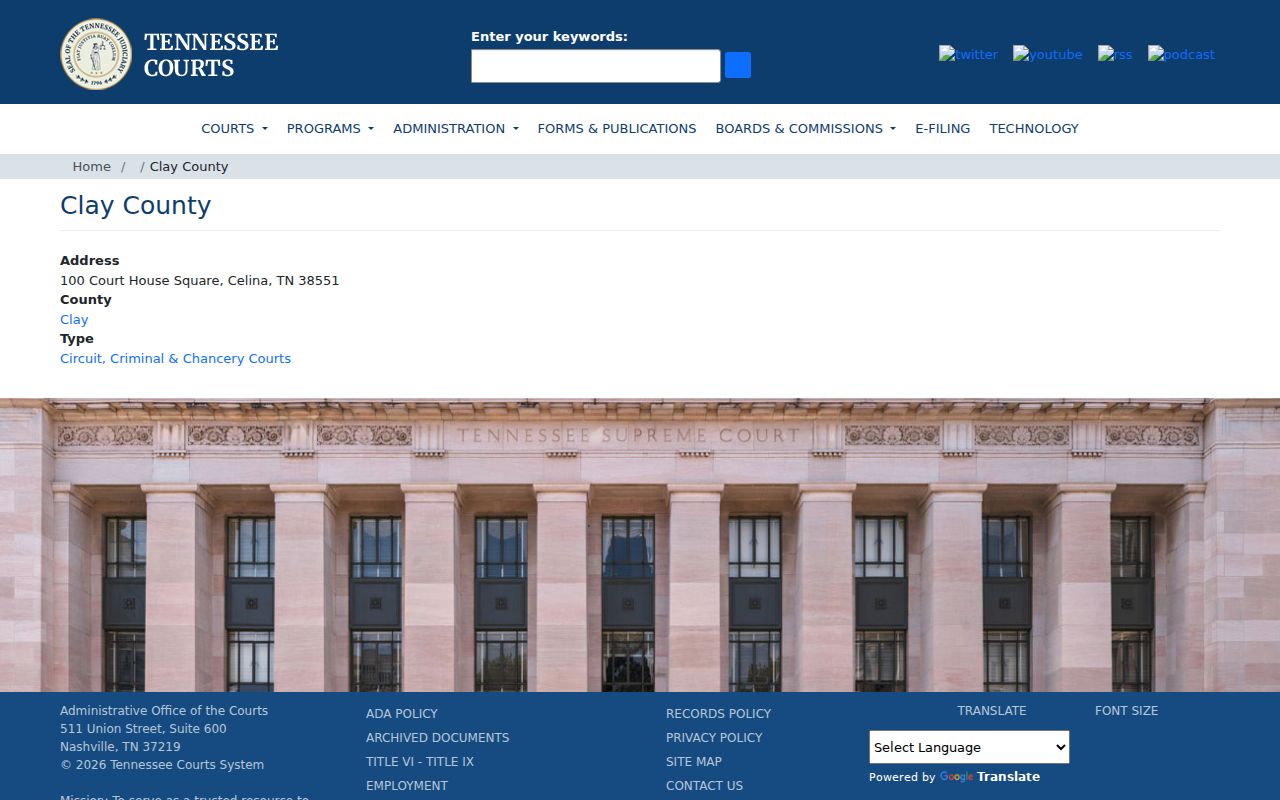
Because official sources describe both Court House Square and Cordell Hull Drive, call the clerk before travel.
Clay County Trial Cases Stay Local
Tennessee's Public Case History, also called C-Track, is not a statewide trial-court lookup. It covers appellate records filed after September 1, 2006. A Clay County misdemeanor or felony that never moved to an appellate court will not appear merely because it exists at the local clerk's office. Searching C-Track first can create a false impression that no trial case exists.
The state page also says results are current through the prior business day and explains the later PDF coverage for appellate documents.
| Search path | Input | Scope |
|---|---|---|
| Appeal case number | Sequence and year | Appellate cases only |
| Case style | Caption text or part | Party caption |
| Party | First and last name | Individual party |
| Organization | Organization name | Organizational party |
Inside a Clay County Case File
A Clay County criminal case file records the judicial proceeding, not just the arrest. The most useful first items are the case number, docket, filed charge, and disposition. Together they show which court acted, how the charge changed, and whether the matter ended by dismissal, plea, trial, or another result. Public financial entries can include fines, court costs, restitution, and credits or payments.
| Case number and court | Identifies the file, division, filing date, judge, type, and current status. |
|---|---|
| Charging document | Shows the complaint, information, or indictment and any filed amendment or dismissal. |
| Docket entries | Lists hearings, motions, pleas, orders, judgment, sentencing, and case-linked capias events. |
| Bond and warrant | May show public bond terms and a warrant or capias date and status. |
| Disposition and judgment | States the result for each filed count rather than the charge listed at booking. |
| Sentence and costs | May show confinement, probation, concurrent or consecutive terms, fines, costs, and restitution. |
Clay General Sessions Court's creating act gives a rare official docket inventory. It calls for the case style and number, process or warrant date, officer return, court actions, orders, judgments, fees, witness fees, executions, garnishments, and credits. That detail explains why a clerk's docket can answer more than a booking entry.
Clay County Docket and Disposition
A narrow request saves time in Clay County. The docket is the dated event list. The disposition is the outcome of the charge or case. Requesting both before ordering a large file can show whether a judgment, dismissal order, or sentencing paper is the one document that answers the question. If the name and rough year are all that is known, ask staff to locate the case number first.
- Capias
- A court command directing an arrest, often after a missed appearance or alleged violation.
- Nolle prosequi
- A formal decision by the prosecutor to discontinue a charge.
- No true bill
- A grand jury decision not to return an indictment.
- Disposition
- The recorded result for a charge or case.
Older Clay County files may require archive or microfilm retrieval. The research found no posted archive schedule or fixed completion time. Tell the clerk the approximate year, ask where the index is kept, and get a turnaround estimate. Certified-copy charges are also a call-before-ordering item because no local fee schedule was verified.
How a Criminal Case Moves
A Clay County felony can begin with a complaint and initial General Sessions events, then move through a grand-jury indictment into Circuit Court. A misdemeanor may remain in General Sessions unless appealed. The filed charge can differ from the arresting officer's label because the prosecutor and grand jury act after booking. Each stage should be read from the docket, not inferred from a rap sheet or jail entry.
Case flow: Charges Filed › Arraignment › Pretrial › Plea or Trial › Disposition › Sentencing
Arraignment is where the accusation is stated and a plea is entered. Pretrial entries may include motions, hearings, or negotiations. A plea or trial leads to a result, while a dismissal or nolle prosequi ends a charge without a conviction. Sentencing follows a conviction and can include confinement, probation, fines, costs, restitution, and conditions.
Note: The Clay County arrest lookup covers booking and agency records, which are separate from the court's filed case.
Clay County Federal Cases Use PACER
Federal criminal cases are not kept in the Clay County court file. Clay lies in the Middle District of Tennessee's Northeastern Division. The Cookeville federal courthouse has courtroom and clerk space, but official instructions say all mail and in-person filings go to Nashville. The division page explains that local arrangement.
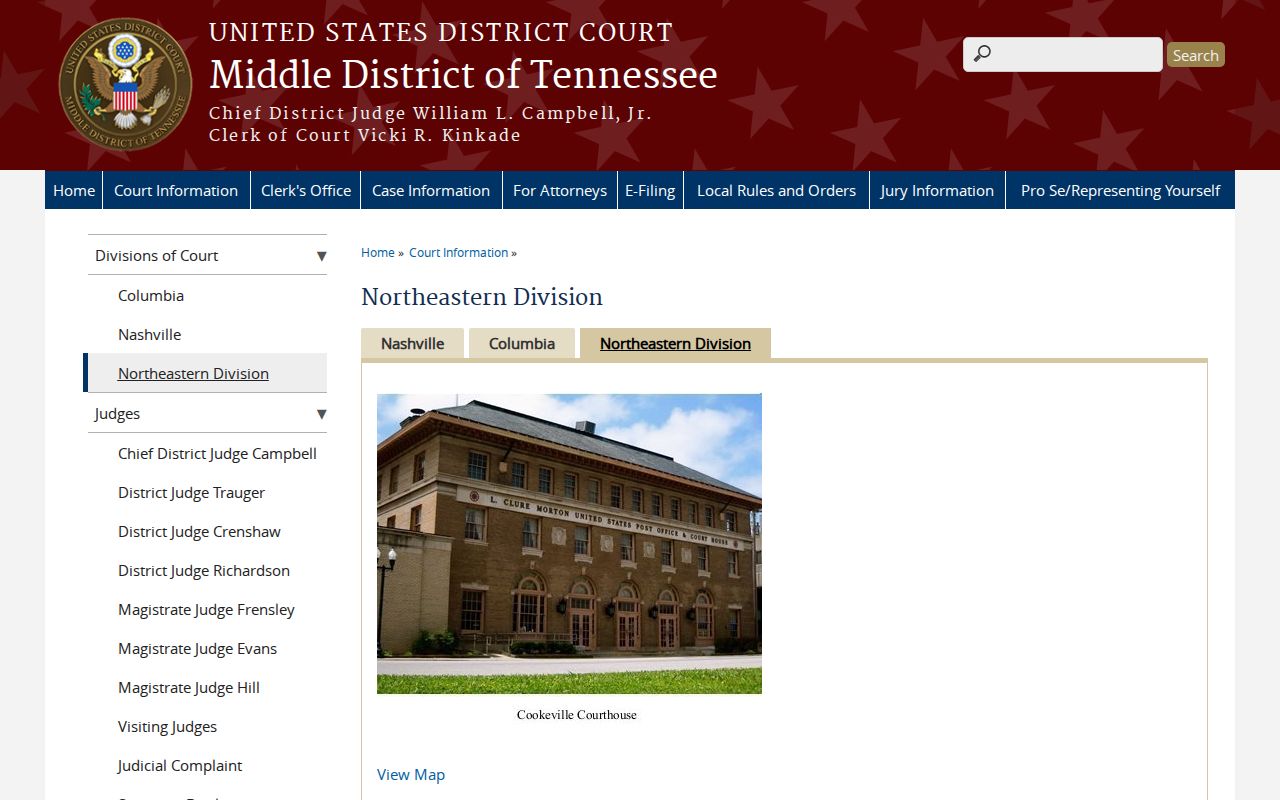
This distinction keeps a federal prosecution from being mistaken for a missing Clay County docket.
PACER is the official federal electronic case system. It charges 10 cents per page, with a $3 cap for a case-specific document or report. The cap does not cover name searches, non-case reports, or transcripts. Quarterly charges of $30 or less are waived, while opinions and courthouse-terminal access are free.
PACER should be used only for the federal layer, never as a substitute for the Clay County Circuit Court Clerk.
Case Record Access & Restrictions
The Tennessee Supreme Court Rule 34 governs access and redaction in court records. The Tennessee Public Records Act also begins with public access for state and local records held by the right custodian, subject to legal exceptions. Access does not make every field public. Social Security numbers, account data, protected victim details, minor information, sealed material, and some active-investigation facts may be removed or withheld.
Juvenile matters are restricted, except where a youth was transferred for adult prosecution under Tennessee law. An expunction order under T.C.A. §40-32-101 can remove qualifying records from public access. If a Clay County case cannot be found, do not assume it never existed. Confirm the court level, spelling, filing period, archive status, and whether an access order applies.
Clay County Case Files Check Rap Sheets
A Tennessee Bureau of Investigation rap sheet groups fingerprint-supported arrest cycles and the dispositions reported back to the state. It is not a copy of the Clay County case. A missing disposition can result from a reporting delay, rejected data, or an identifier mismatch. The local docket and judgment remain the best sources for what the court actually did.
Compare records in the right order. Use the booking file for custody facts, the Clay County court file for filed charges and outcomes, and TORIS for the broader Tennessee identity-linked history. If the court record supplies a result that TORIS lacks, keep the certified disposition and follow the TBI correction route rather than guessing from the arrest entry.